Caretaker Adventures

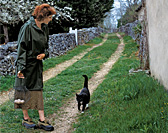 Photo by Evan Sklar
| Follow Your Dreams (for Next to Nothing)  Imagine staying in some of the loveliest locations on earth—and all you have to do is feed the cats |
 |  | |

Resource Guide: Finding the Freebies
Considering Caretaking? Be Sure to Ask These Questions
Web Exclusive: Out-of-the-Ordinary Vacations
Book Your Travel Online with AARP Passport
AARP.org’s Destinations Channel (AARP.org)
Subscribe to the Travel Email Newsletter (AARP.org)

When the early morning sky sears pink and the moon recedes south toward Toulouse, I follow the gravel path to the hen house. Lulu, my feline companion, trots alongside me on the stone wall. At the shepherd's hut we pause to gaze at a view of pastures that has remained largely unchanged since the Middle Ages, when the stone structure was built. The foxes and wild boars that roam the night have returned to the deep woods, and the hens are ready to begin their day. I open the hen-house door, toss corn feed onto the ground, and the hens strut out their brilliant plumage. In their nest are two warm eggs for my omelet.
A northeasterly wind carries the clatter of Raymond Leris's sheep as they clamber from his stone barn. At 7:00 a.m. the bells of L'Église de Saint Leonard toll.
It is my second week in Escamps, a cluster of medieval farms and impossibly narrow roads in southwest France, a region known as The Lot, in the Midi-Pyrénées. There are no shops in this hamlet, only a church, an ancient cemetery, and a tiny bibliothèque whose librarian, Monsieur Dubillion, I nearly ran over in my tiny rented Renault. Still, word of my housesitting at Sophie Dumont's farm, Piepalat, has preceded me, and on my daily walks residents often invite me for a cup of espresso or a slice of their goat cheese. In the language I learned from my French mother, I chat with farmers and masons whose ancestors have lived here for centuries.
AARP: Discounts on Airfare, Cruises and Car Rentals
AARP members save on airfare, cruises, car rentals, hotels and lodging, vacations and tours. Joining AARP online is fast, easy and only $12.50/year.
I came to Sophie's 200-year-old farmhouse through HouseCarers.com
During the day I drive to vineyards and red-roofed villages built on the walls of Roman fortresses.
One opportunity seemed ideal: taking care of cats in a French farmhouse for a few weeks. I e-mailed the homeowner. Remarkably, she replied within days. Sophie Dumont spends extended time in London, where her husband works, and her four cats and five hens need tending at her farm in Escamps. For years she has relied on European or Australian house sitters; I would be her first American. We immediately connected as impassioned animal lovers, and Sophie mailed laminated photos and personal histories of Lulu, Bijoux, Chouchou, and Mia. She also offered me some advice: avoid a local dentist ("We call him the butcher") and "Don't fall in love with a Frenchman!"
My French housesitting experience began when the train to Toulouse labored to a stop at Cahors, a 12th-century town five hours from Paris and 20 kilometers (12.4 miles) from Escamps. An energetic former Parisian in her late 30s, Sophie Dumont meets me at the station with the customary French three-cheek kiss. In the Renault I follow her SUV along narrow roads bordered by medieval ruins and rocky pastures. Sophie's limestone farmhouse is tastefully renovated. White shutters, which I must latch on these cool March evenings, frame the many tall windows. Inside, the walls are also stone, with beamed ceilings and terra cotta tile. I notice clearly defined cat paw prints and others that look web-footed embossed on those tiles. Sophie explains that farm animals had scurried across the tiles when they were freshly baked in the 17th century. That would make those footprints about 400 years old. I consider my own home, circa 1900, historic—but my perspective is changing quickly.
Sophie is well organized and has a definite standard of care. Her housesitting contract requires a 1,000-euro deposit (about $1,300), payment of utilities, and seasonal groundskeeping. Most important, she emphasizes, is the well-being of her cats. Lulu, Bijoux, Chouchou, and Mia observe me suspiciously as Sophie explains their menus: alternating days for tuna, pâté, fresh steak, and cod. I must defrost the steak and fish the prior night, then sauté the fillets in the morning. "Can I prepare these meals in advance?" I ask, eyeing the microwave. Sophie looks horrified. "Absolument non! They will only eat freshly cooked!" We move on to housecleaning and hen feeding. Sophie graciously introduces me to her artist friends and farming neighbors, and then drives off to London, about ten hours away, with her young son, Zac.
Sophie, the homeowner, also offered some advice: ‘Don’t fall in love with a Frenchman!’
My official housesitting begins with a morning downpour. I prepare cod pas bien cuit ("lightly cooked") for wary cats, pull on rain gear, and head to the hen house. The hens take one look at me and flee to the farthest field. Eventually I earn their trust with the help of ample vegetable remnants. That the Midi-Pyrénées region is the foie gras capital of the world presents a distinct problem for a vegetarian like me. Menus read like a textbook in duck anatomy, from foie de canard ("duck liver pâté") to confit de canard (which turns out to be preserved duck thighs). Perforce, the lively outdoor markets in nearby Lalbenque and Limogne, where vendors offer me generous samples of their cheeses, fruits, and favorite recipes, and locally grown vegetables of every sort abound, quickly become my favorite destinations. Thick, tasty soups, local goat cheese, and bountiful salads are my new mainstays. For their part, the hens enjoy my salad remains, and in turn provide me with fresh eggs for savory soufflés.
During the day I drive to vineyards and red-roofed villages built on the walls of Roman fortresses. I spend hours in Saint-Cirq Lapopie, an ancient cliffside village that has been an artists colony since the early 1900s. At cafés in Cahors I sip vin noir de Cahors, the local dark red wine, and observe town life. I envision myself an expatriate and even enlist a real-estate agent to show me village houses. At dusk I share Piepalat's courtyard bench with Lulu and Chouchou, and listen to the day end in Escamps—its sheep clattering into barns, the shrill cries of peacocks at a neighbor's château, dogs barking. Evenings, I dine with Sophie's friends, Claire and Catharine, or savor a vegetable stew at a family-run restaurant in the hamlet of Bach. I also indulge in one breathtaking five-star dinner.
The night of my birthday I awake to what sounds like a train crashing in the courtyard. A fierce wind is banging the shutters, and an icy rain pelts the French doors. The electricity is out, and there is no heat. I can't find the fuse box, and the phone is dead. I hastily light a wood fire at the massive hearth, pull a day bed close to the flames, and plunge under the duvet with Lulu for a medieval sleep.
It is hailing in the morning when Jean-Pierre Kerambrun appears at the back door. When she could not reach me by phone, Sophie dispatched Monsieur Kerambrun, who will assume housesitting duties when I leave. A former gendarme who is caretaking another of Sophie's properties, Monsieur Kerambrun investigates. He discovers the fuse box recessed in a stone wall in a bath-room. Confidently, he flips a switch and—voilà!—lights! The kitchen, though, remains dark, and the radiators are quiet. Daniel Dumont, Sophie's father, suddenly arrives from his home in neighboring Cremps. Sophie, it seems, has summoned the troops to my aid. Monsieur Dumont surveys the kitchen. He frowns, sighs, then gives a Gallic shrug. I'm envisioning another freezing night when Sophie's carpenter, the dashing Laurent Moles, sweeps into the house. Laurent winks at me through a mop of blond hair and announces, "Allez!" ("Let's go!") We are filing back to the fuse box when, miraculously, the phone rings. It is Sophie calling from London. In rapid French she instructs Laurent on the vagaries of the fuse box and, within minutes, the house is ablaze with lights. We applaud our success.
My caretaking stint winds down in mid-April, but it is difficult to leave. On my last morning I toss the hens extra grain and cook a cod fillet for my feline friends. I still pose a vehicular hazard to Escamps residents, but I have also made new friends. Their world, so different from mine, is inspiring in its richness of community and shared history.
I hand Monsieur Kerambrun Piepalat's key and make my way back across the centuries to my home and a $250 pet sitting bill. Within days I am planning another housesitting adventure, this one in England. I log on to a few websites and post my own ad: "House sitter needed for four happy southern hounds…" Any takers?
My caretaking sojourn in France was idyllic, and caretaking enthusiasts I spoke with afterward were not surprised I was smitten. "Once people discover caretaking, they often make it a part of their lives," says Gary Dunn, publisher of The Caretaker Gazette, a Texas-based bimonthly publication, many of whose 10,000 subscribers are over 50. Indeed, boomers and retirees in particular appear to have taken to housesitting in a big way, attracted by rent-free living in some of the world's most beautiful and exciting locales. Ian White, founder of Australia-based HouseCarers.com, reports that retirees have become his biggest market in recent years. "Retirees are at a prime time in their lives to follow their dreams and move to a location that would be considered an impossibility in years past," White says.
When I placed ads in The Caretaker Gazette and on HouseCarers.com, asking how other house sitters had fared, the response was also nearly uniformly positive.
Wisconsin retirees Shelly and David Hamel were in their late 50s when they fell in love with life-off-the-grid during their first assignment on the Aleutian Islands. Now in their 60s, they are caretaking at an inn in San Miguel de Allende, Mexico. "Caretaking is a great way to see the world on the cheap for retirees, if you happen to be fit," Shelly enthuses.
Some caretakers reported glitches, from an exorbitant heating bill in an Italian farmhouse to finding that their nearest neighbor was a kennel of barking dogs. In some cases the homeowner's ad was not quite representative of the assignment. A "guy Friday" posting for a Caribbean compound lured retirees Pat and Larry Hilliard from their home in Falls Church, Virginia, to the tiny Netherlands Antilles island of Saba. According to the homeowner, he needed only "a few hours' help Monday-Friday, gardening and odds and ends." Before leaving, the Hilliards, both in their late 50s, speculated with great excitement about their Saban routine. "We'll grow a garden, do a lot of walking and hiking, try out all the restaurants, read," Larry wrote in their newsletter, The Saban Sun.
Not quite. What sounded like paradise turned out to be a sort of tropical work camp. During the several weeks the homeowner was present, he set an arduous schedule. The Hilliards mulched and mowed more than two acres of gardens, watered the owner's private jungle in a drought, and cleared vegetation during unexpected torrential rains. In the absence of car rentals, grocery shopping in the village of Windwardside meant trekking on foot over mountainous terrain. By the end of their first month, Larry had lost 13 pounds.
The simply furnished one-bedroom, one-bath cottage was less luxurious than the Hilliards' condo, but its view was of the spectacular Mount Scenery range. The island's beauty notwithstanding, the Hilliards left in July, well ahead of the year commitment requested by the owner. "I guess our 'surprise' had more to do with our own expectations and preconceived notions," Larry readily admits. Would they caretake again? "Definitely," says Pat. "But I'd be sure to ask how much and what type of heavy manual labor is involved."
Above all, it takes adaptability and resourcefulness to make caretaking work. "You have to be able to think creatively," says Harry Denkers, 55, whose family weathered rugged living on an island off the coast of Maine. When they first set foot on Seguin Island, the Denkerses marveled at the scent of bay leaves—and life's unexpected turns. Land-bound Canadians, they would be caretaking a lighthouse on this rocky island three miles from the shore.
The Denkerses had been among hundreds of applicants for the summer position that was advertised in The Caretaker Gazette. They were the first family with young children chosen by the Friends of Seguin Island, which manages the isle. In summer 1996 Lawrene, now 44; Harry; and their two preteen daughters honed skills they had developed on their Ontario farm. They replaced shingles, repaired walkways, laid down flooring, and maintained the 64 wild acres that are home to seals, sea birds, and a 19th-century lighthouse. They also greeted thousands of visitors to the island.
The Friends of Seguin Island clearly detailed the caretakers' duties. "There were no surprises as to our responsibilities, only the surprising beauty of the place and how attached to it we became," Lawrene says. For three months the family lived in the spartan caretaker's quarters that adjoin the small museum. Once a week a boat took them to the mainland for provisions. They were enchanted by the remote beauty and became lifelong friends of mainland residents.
For one week every summer since then, the family returns to Seguin Island to prepare the grounds for its new caretakers. There is always winter's damage to undo: shingling, painting, checking for water-line leaks, fixing the overworked sump pump, and rebuilding outdoor stairways.
Last year a sea storm delayed the Denkerses' departure and the arrival of the summer's caretakers, a Pennsylvania couple in their 60s. "You have to be a family that takes things in stride, and we discovered that we are," Harry says. Lawrene also learned something about herself. "Taking three months off in the middle of our lives seemed irresponsible, but it became the best decision we could have made at that time. I learned that you don't need much stuff to get along, and that people are more important than place."
Judith Reitman is the author of several nonfiction books, and her award-winning articles have appeared in The Atlantic Monthly and The Village Voice. She is spending increasing time in France.
Check Out My Other Blogs (click on blog name to go there) = / 1.3rd Eye Blog / 2. Favorites Blog/ 3. Vita Excolatur (Living Well ...) Blog/ 4. Humor Me Blog/ 5. News and Current Events Blog/ 6. Consider This ... Blog/ 7. Consumer Warnings Blog/ 8. New Orleans Pentimento Blog/ 9. We Constant Gardeners Blog/ 10. Chaillot Family Blog/
posted by Joe Paris at Friday, June 15, 2007
|
0 comments


